Bitcoin Cycles: Euphoria, Panic, and the Art of HODLing
The market changes its story with the price. A misspelled forum post offers a surprisingly useful lesson in how to respond.
- The idea
- A calm process can help resist euphoria and panic.
- Main risk
- A cycle story can become an excuse to ignore a broken thesis.
- What to watch
- Position size, changing assumptions and decisions made before emotions peak.
At the top, patience suddenly looks foolish. Everyone seems to know someone who made a fortune, and yesterday’s ambitious price target becomes today’s conservative one. At the bottom, the same asset can feel embarrassing to own. The technology may not have changed nearly as much as the conversation around it.
Bitcoin is a useful example because its story combines monetary conviction with intense speculation. Understanding that combination does not reveal the next turning point. It can help explain why your own decisions may feel most urgent when they deserve the most scrutiny.
First comes the idea. Then comes the crowd.
Satoshi Nakamoto’s 2008 whitepaper proposed peer-to-peer electronic cash, and the network began operating in 2009. The starting point was a way to transfer value without a central payment intermediary. The later investment story added scarcity, savings, and the possibility that a growing number of people would want to hold the asset.
A price rise can bring attention. Attention brings new buyers, promoters, leverage, and more persuasive stories. Real progress and speculation can reinforce each other. The danger comes when rising prices are treated as sufficient evidence that every claim is true.
The emotional cycle
Disbelief can become curiosity, curiosity can become conviction, and conviction can become euphoria. During the climb, it becomes easier to imagine the upside and harder to imagine needing the money. During the decline, that balance reverses. A plausible long-term thesis suddenly feels less persuasive than the red number on the screen.
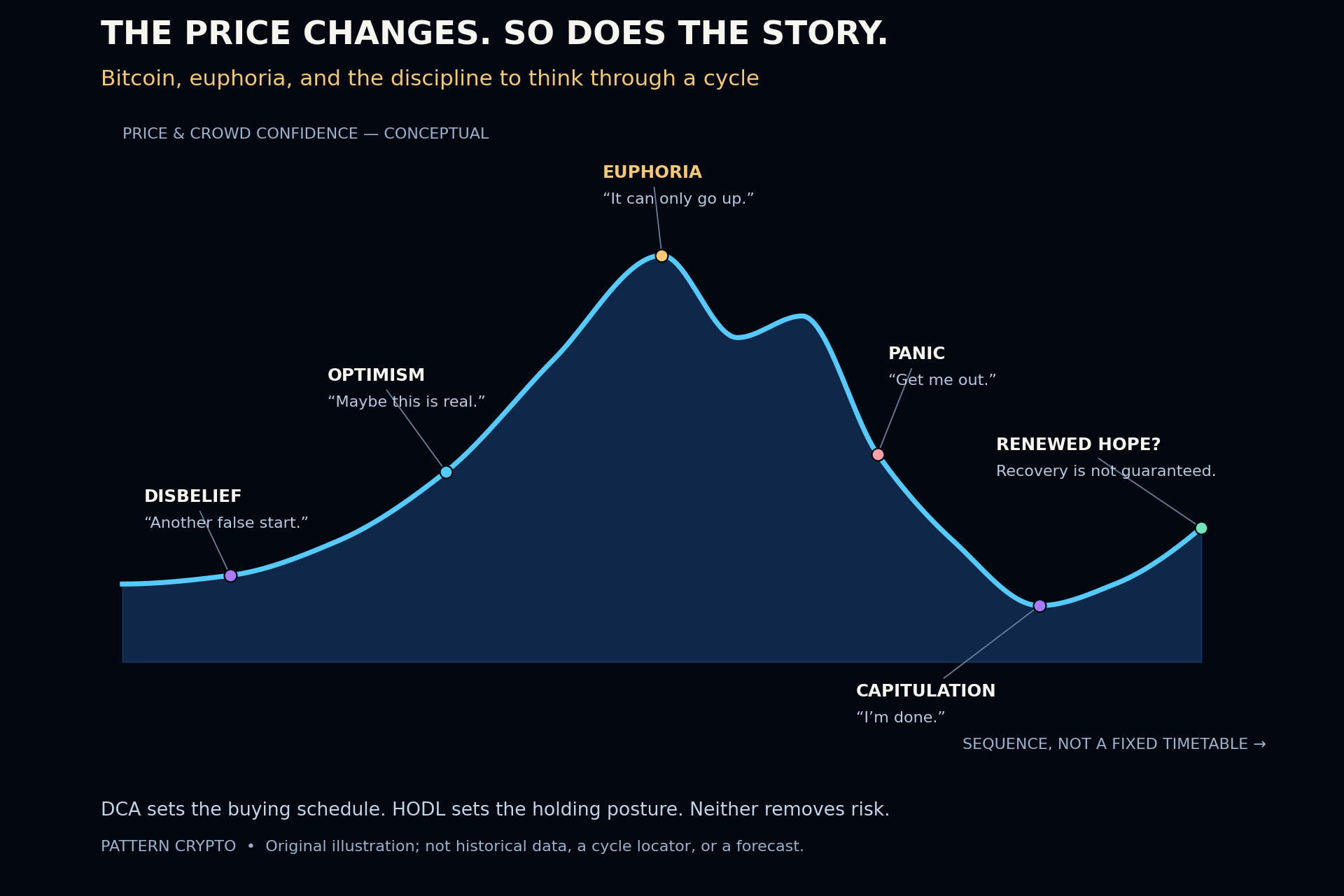
The chart deliberately has no price scale or calendar. These moods can overlap, repeat, or fail to appear in order. The crowd is not one person with one emotional state. A recovery may fail, and a convincing-looking peak may be followed by a further rally.
A supply schedule is not a market timetable
Bitcoin’s block subsidy halves every 210,000 blocks, approximately every four years. That changes the rate of new issuance. It does not set the amount buyers will pay. Liquidity, borrowing conditions, access, selling pressure, and changing expectations can overwhelm a simple cycle story.
A handful of historical cycles is a small sample, especially when the market’s size and participants have changed. A halving can be relevant without being a clock you can trade with certainty. Knowing the schedule is different from knowing what has already been priced in.
December 18, 2013: a typo becomes a philosophy
On BitcoinTalk, a user named GameKyuubi published a post titled “I AM HODLING.” Bitcoin was falling, and the author admitted to drinking and being bad at trading. The misspelling survived because the frustration was recognizable: knowing afterward when you should have sold is easier than doing it beforehand.
“It's because I'm a bad trader and I KNOW I'M A BAD TRADER.”
GameKyuubi · BitcoinTalk · December 18, 2013
HODL began as a misspelling of holding, not an acronym. Its original force was an admission of limited market-timing ability. The post did not supply a valuation model or prove that holding any coin indefinitely would succeed.
Original source: BitcoinTalk, “I AM HODLING,” GameKyuubi, December 18, 2013, topic 375643, first post. Checked September 19, 2026.
HODL is a posture. DCA is a buying method.
Holding means keeping an existing position through price fluctuations. Dollar-cost averaging means committing a fixed amount on a regular schedule. You can do either without doing the other. Someone can buy once and hold, or buy regularly while periodically rebalancing.
DCA can reduce the pressure to make one perfectly timed decision. Equal dollar purchases acquire more units at lower prices and fewer at higher prices. But it cannot make a failing asset recover. Spreading an existing cash balance over time can also lag investing it immediately when prices rise. Investing from each paycheck is different from deliberately leaving an available lump sum in cash.
Conviction needs an escape from denial
There is a difference between enduring volatility and refusing to reconsider. A useful holding thesis explains why the asset should remain desirable, what risks you accept, and what evidence would change your view. “It has to come back” answers none of those questions.
Bitcoin’s monetary thesis should be assessed on its own merits. Extending its history to every new token is a dangerous shortcut. A thinly traded coin with insider controls can disappear while its holders faithfully repeat the same slogan.
Write the rules while you are calm
Before buying
Choose an affordable exposure limit, keep essential reserves separate, and understand custody. Avoid borrowing to sustain a position.
During euphoria
Compare your allocation with the limit you chose. A rally can concentrate your finances without another purchase. Revisit the evidence before increasing your stake.
During panic
Separate a price decline from a damaged thesis. Review security, liquidity, and personal cash needs. Neither automatic selling nor automatic buying fits every situation.
At scheduled reviews
Ask whether the original reasons still hold. A changed financial situation or broken assumption can justify a different decision.
The advantage is a process you can live with
You do not need to identify the exact peak to notice that your position has become too large. You do not need to identify the bottom to choose a purchase schedule you can afford. And you do not need to trade every swing to participate in an asset’s long-term outcome.
The most useful lesson in HODL is humility. You can believe an asset has a future while admitting you cannot predict next Tuesday. Pair that belief with manageable exposure, periodic review, and room to change your mind. The goal is to make decisions you can explain after the excitement has passed.
Background sources: Bitcoin whitepaper (2008); Bitcoin.org FAQ, supply and issuance; FINRA, The Benefits and Limitations of Dollar-Cost Averaging (May 19, 2026). Reviewed September 19, 2026. Cycle interpretation and chart are original editorial analysis.
Educational commentary prepared with AI assistance under James Clayton’s editorial direction. The editor holds BTC. This is not individualized financial advice, a cycle-timing signal, or a promise of recovery. Crypto assets can suffer permanent losses.