The Bull Case for Bitcoin: Scarcity With a Global Address
Bitcoin does not need to replace every bank or currency. The optimistic case is that more people come to value a monetary asset no single issuer controls.
- The idea
- Verifiable scarcity gives Bitcoin a clear monetary proposition.
- Main risk
- Scarcity cannot guarantee demand—or a sensible entry price.
- What to watch
- Durable monetary use and resilient network security.
A monetary system you can verify.
“What is needed is an electronic payment system based on cryptographic proof instead of trust”
Satoshi Nakamoto
Bitcoin: A Peer-to-Peer Electronic Cash System, introduction (2008); excerpt. Verified September 19, 2026.
The excitement begins with a change in who must be trusted. Satoshi proposed a way for participants to transact without relying on a central payment intermediary. Our bullish interpretation is that this independence can be valuable alongside verifiable scarcity: people may want to hold an asset whose rules and transfers are checked by a network rather than controlled by one issuer. The quote explains the original purpose; the investment case still depends on people continuing to value it.
What the documentation establishes
- Supply is limited to 21 million BTC under the current rules.
- Transactions are validated through the network rather than a central issuer.
How to read it: These establish monetary design, not a floor under the market price.
Source: Bitcoin.org — FAQ. Checked September 19, 2026. Documentation facts, not a live adoption dashboard.
The bull case
Bitcoin asks a monetary question before it asks a technological one: what would people pay to hold an asset whose issuance is governed by verifiable rules rather than a central issuer? Its 21-million supply limit gives that question a clear starting point. The investment case begins when someone finds those properties worth owning through an uncomfortable market—not merely worth discussing during a rally.
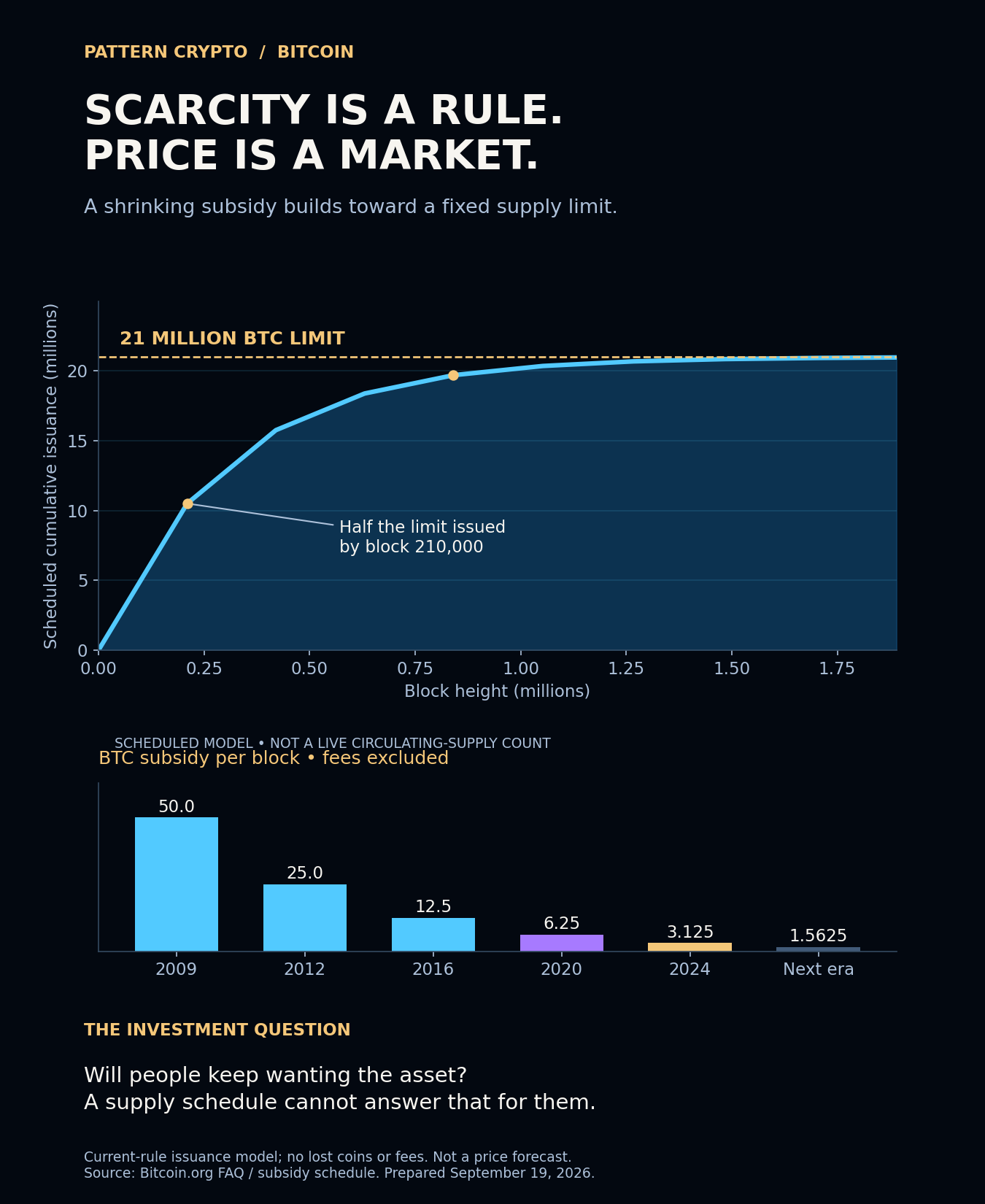
Read the chart as text
Scheduled cumulative issuance: 10.5 million BTC at block 210,000, 15.75 million at 420,000, 18.375 million at 630,000 and 19.6875 million at 840,000. Subsidies by era: 50, 25, 12.5, 6.25, 3.125, then 1.5625 BTC per block. Fees and lost coins excluded. Demand determines what buyers will pay.
The positive scenario is expanding monetary demand. Bitcoin need not become everyone’s everyday payment method to have a larger role in savings, settlement, or portfolio allocation. If a broader pool of buyers wants to hold it over time, a supply that cannot expand freely in response could support higher prices. That is a conditional argument about demand meeting constrained supply—not a forecast that every halving causes a rally.
Background sources: Bitcoin.org — Frequently Asked Questions: supply, monetary properties, mining, and risks. Reviewed September 18, 2026. The investment interpretation is Pattern Crypto analysis.
The scarce asset still needs a buyer
Imagine two futures with exactly the same supply rules. In one, more people want a portable asset outside a central issuer’s control. In the other, that preference fades. Bitcoin is equally scarce in both futures, but the investment outcomes can be very different. A fixed supply constrains the response to demand; it does not create demand.
The useful distinction is between temporary buying and a lasting reason to hold. A buyer chasing this month’s momentum can disappear quickly. Someone using BTC as a long-term monetary allocation may behave differently, although neither group is immune to panic. Our strongest version of the thesis is growing monetary relevance through several market environments—not a mechanical prediction based on the next supply milestone.
What would change our mind?
We would become less optimistic if broader access and recognition repeatedly failed to produce durable holding demand. A rising price alone would not resolve that concern.
Analytical illustration, not reported project activity or a price forecast.
The neutral case
Bitcoin could remain a durable, widely traded monetary asset while delivering modest or uneven returns. Existing expectations may already reflect substantial future adoption. A network that succeeds and an investor who pays too much can coexist; neither a supply cap nor longevity establishes fair value.
The bear case
Demand could stagnate or migrate elsewhere, while restrictive access, custody failures, leverage, or security concerns undermine confidence. BTC provides no operating-company earnings or dividend to anchor a valuation. Scarcity alone cannot prevent deep losses when buyers retreat.
Educational fundamentals analysis, prepared with AI assistance. Not individualized financial advice. These scenarios are not probability estimates, guarantees, or claims that the asset is attractively priced today. Review your own circumstances and risk tolerance before investing.