Dollar-Cost Averaging: Build a Position, Not a Prediction
A regular buying plan can make volatile markets easier to navigate. Asset quality and position size still come first.
- The idea
- A regular buying schedule reduces the pressure to time one entry.
- Main risk
- Repeated buying cannot make a failing asset recover.
- What to watch
- Affordability, fees, concentration and whether the original thesis still holds.
A schedule you can actually keep
Dollar-cost averaging means investing a fixed dollar amount at regular intervals. You buy more units when prices are lower and fewer when they are higher. Its practical appeal is behavioral: a decision made calmly in advance can replace the pressure to guess the perfect entry every week.
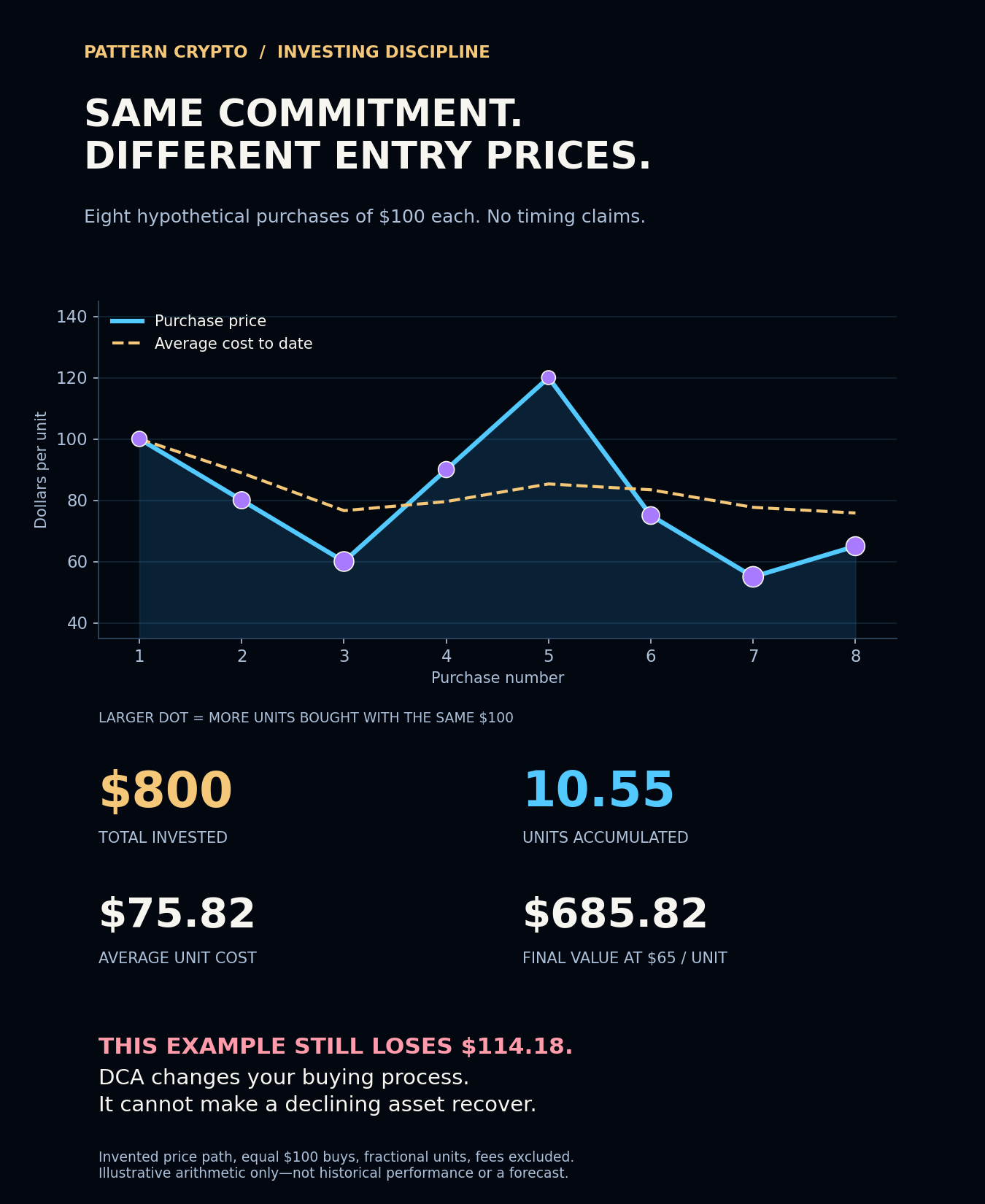
Read the chart as text
Purchase prices: $100, $80, $60, $90, $120, $75, $55 and $65. Total invested $800. Units accumulated 10.5519. Average cost $75.82. Final value at $65 per unit is $685.82: a loss of $114.18 before fees. Dots scale with units purchased; the dashed line is cumulative average cost. Hypothetical, not historical performance.
For a fundamentals-focused crypto approach, Bitcoin and Ethereum are natural starting points for research because of their long operating histories and distinct monetary and network roles. That is an editorial starting point, not a guarantee of safety or a claim that either is cheap. Solana can be studied separately as a platform thesis with a shorter history and different risks. Owning several crypto assets is still concentrated exposure to one volatile sector.
Choose the asset before automating the purchase
A recurring buy cannot repair a broken investment thesis. Understand why demand might persist, how supply changes, how the network is secured, and why its token should capture value. An established name offers more history to examine; it does not prevent permanent losses.
Set an overall crypto exposure limit before choosing a weekly or monthly amount. Keep essential spending and emergency money outside that budget. Avoid borrowing to maintain a schedule. Compare fees and spreads, because small frequent purchases can be costly, and think through custody before accumulating a meaningful balance.
A simple illustration
Suppose an investor makes three hypothetical $100 purchases at prices of $100, $50, and $100 per unit. They acquire 1, 2, and 1 units: four units for $300, averaging $75 per unit before fees. At a final market price of $60, those units are worth $240—a $60 loss. Buying regularly improved the average entry relative to the first price; it did not guarantee a profit.
Understand the trade-off
Spreading an existing cash sum over time leaves some money uninvested. That can soften initial exposure during a decline but lag an immediate purchase during a rising market. Investing new income as it becomes available is different: there was no earlier lump sum waiting to be deployed. DCA is a method for managing decisions and entry timing, not a universal return advantage.
Review the plan, not every candle
Choose periodic reviews for affordability, portfolio concentration, fees, and whether the underlying thesis still holds. A price decline alone does not settle that question. A security failure, changed token economics, or a genuine need for the money can justify revisiting the plan.
What DCA cannot do
It cannot prevent a prolonged collapse, protect against exchange or wallet failures, or make an unsuitable asset suitable. Continuing to buy something that never recovers can compound the loss. Discipline includes knowing when the assumptions have changed.
Background sources: FINRA — The Benefits and Limitations of Dollar-Cost Averaging (May 19, 2026). Crypto selection, risk framework, and numerical illustration are Pattern Crypto analysis. Reviewed September 18, 2026.
Prepared with AI assistance. Editorial preferences are opinions, not performance forecasts. The editor holds crypto assets discussed on this site, which can create bias. Assess affordability, concentration, and the possibility of permanent loss.